Development
The Tuapeka linear turbine has developed through a series of experimental designs and field tests extending over several decades. Early turbines were tested in Japan and Thailand in the 1980s, followed by the development and testing of new prototypes in New Zealand from 2012 onwards.
The tests have investigated the use of the linear turbine for extracting energy from river, canal and tidal flows, including applications for pumping water and generating electricity. The design has evolved through practical testing under a variety of flow conditions.
Early Development — Japan and Thailand, 1984–1986
Early open-channel linear turbine tests were carried out in Fukui, Japan, in 1984, in the Kuzuryu River and an irrigation canal. The tests included pumping water and demonstrating that the turbine could rotate in the same direction irrespective of the direction of water flow, a useful characteristic for tidal-flow applications.
Further tests were carried out in the Pai River in northern Thailand in 1986. The turbine was used to pump water to a village and to generate electricity for a light.
Linear turbine tests in Fukui, Japan, 1984 — Kuzuryu River and irrigation canal.
Linear turbine tests in the Pai River, northern Thailand, 1986 — pumping water and generating electricity.
Prototype Development in New Zealand — 2012
Development and testing of a new prototype continued in New Zealand in 2012. Initial tests were followed by trials in the Waikato and Clutha Rivers, and development of the Mark III version of the turbine for demonstration at Fieldays.
19 January 2012 — Auckland Prototype Test
An early prototype was tested in a swimming pool in Mount Eden, Auckland. The flotation test passed, while the driving test did not quite pass and the transportation test was described as “semi-passed.”
7 February 2012 — Waikato River Test
The prototype was subsequently tested in the Waikato River. This was an early opportunity to operate the turbine in a natural river flow rather than the controlled conditions of the Auckland swimming-pool test.
26 February 2012 — Tuapeka Punt, Clutha River
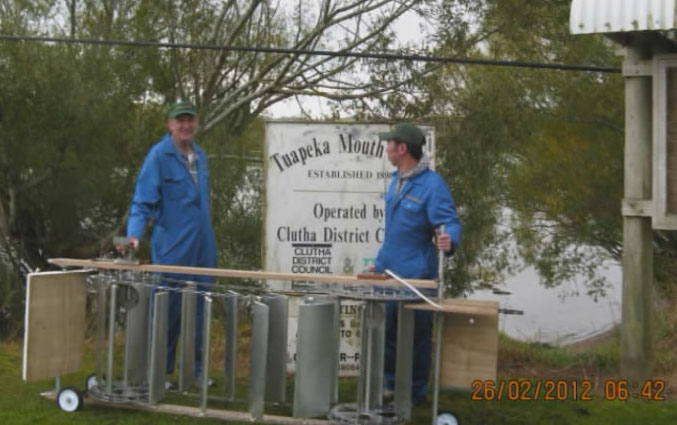
The turbine was tested in the Clutha River during the Tuapeka Punt picnic. The operating principle was compared with that of the Tuapeka Punt: the punt uses the river flow and rudders to move sideways across the river, while the turbine uses blades suspended on chains and inclined to the flow to produce transverse movement and turn the wheels at each end.
16 June 2012 — Mark III at Fieldays
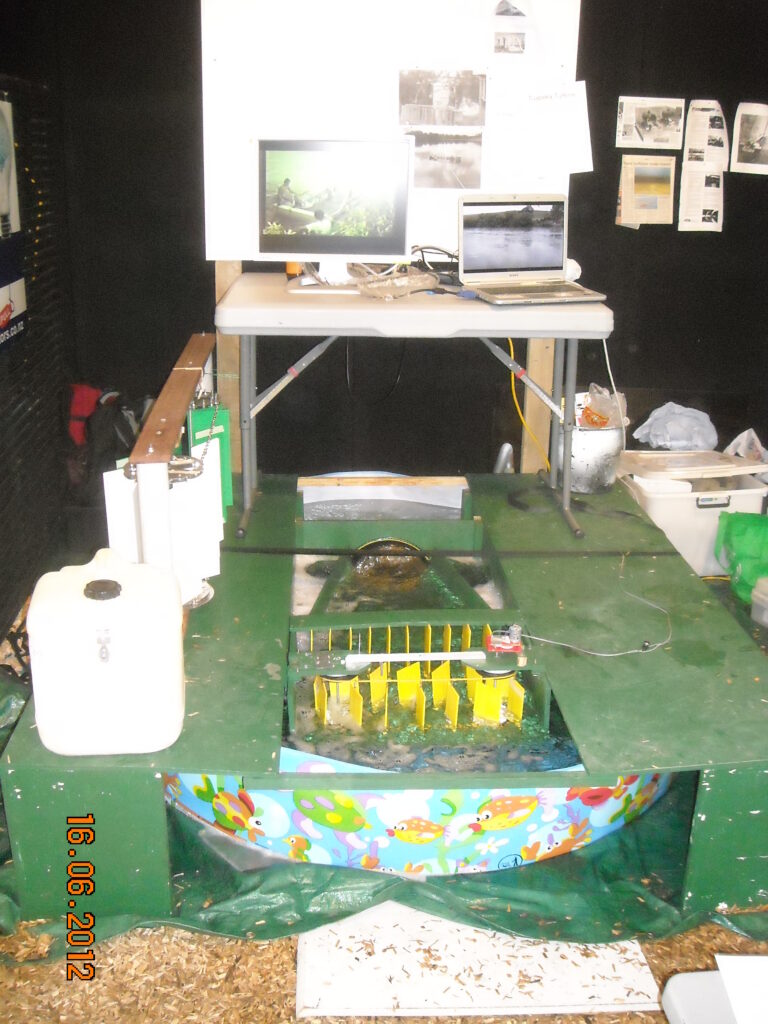
The Mark III version of the Tuapeka turbine was demonstrated at Fieldays at Mystery Creek, Hamilton. A child’s play pool was used to simulate a river, with an underwater scooter propulsion unit providing the flow at the far end of the test tank and straightening vanes positioned upstream of the turbine.
Tidal Testing and Further Development — 2013
Development continued in 2013 with testing in tidal flow and further consideration of how the turbine could be made lighter, stronger and easier to manufacture. Work also considered alternative generators, changes to blade and wheel dimensions, and other improvements intended to increase performance and make the design more practical.
17 January 2013 — Orewa River Tidal-Flow Test
The turbine was tested in tidal flow in the Orewa River, New Zealand. The test configuration used two 500 watt alternators for electricity generation, with a chain-and-belt step-up drive giving approximately 2000 rpm. A water pump was fitted at the other end using a crank drive; the pump was made from PVC pipe with two glass balls acting as check valves.
Development Objectives
- Reduce weight while increasing structural strength.
- Develop construction methods suitable for manufacture in developing countries.
- Investigate stronger alternatives to bicycle chain for higher-power turbines.
- Investigate alternative slow-speed electrical generators.
- Investigate wider blades and larger wheels to improve performance.
- Investigate the possible use of intermediate stator guide vanes.
- Develop educational material explaining the turbine and its construction.
- Continue development of computer programs for turbine analysis and design.
Field Testing of the Mini Linear Turbine — 2014
A series of field tests was carried out during 2014 to investigate the performance of the mini linear turbine under different natural flow conditions. Tests were conducted at several sites in New Zealand and included electricity generation, voltage measurement and water pumping.
24 January 2014 — Heathcote River, Christchurch
The mini linear turbine was tested in the Heathcote River in Christchurch. This was the first of several Heathcote River tests recorded during 2014 and was followed by further work on power generation and water pumping.
22 February 2014 — Lake Taupo
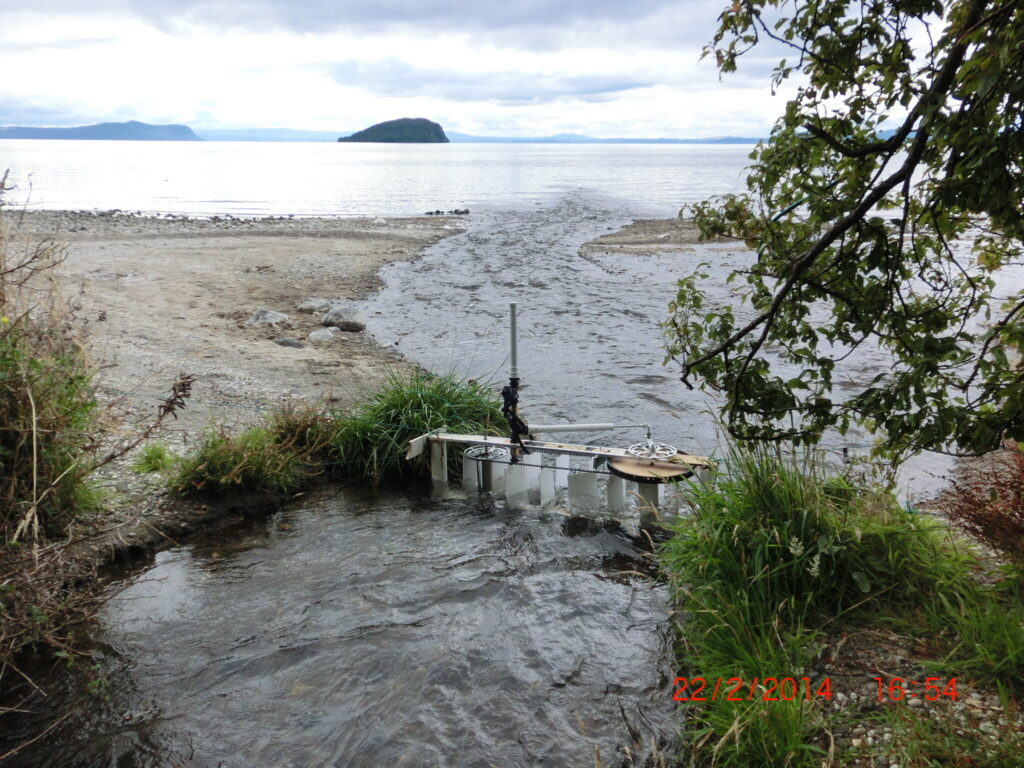
The mini linear turbine was tested at the mouth of the Waimarino River at Lake Taupo. The surviving record of this test includes a photograph of the turbine at the test site.
14 March 2014 — Whakatane River
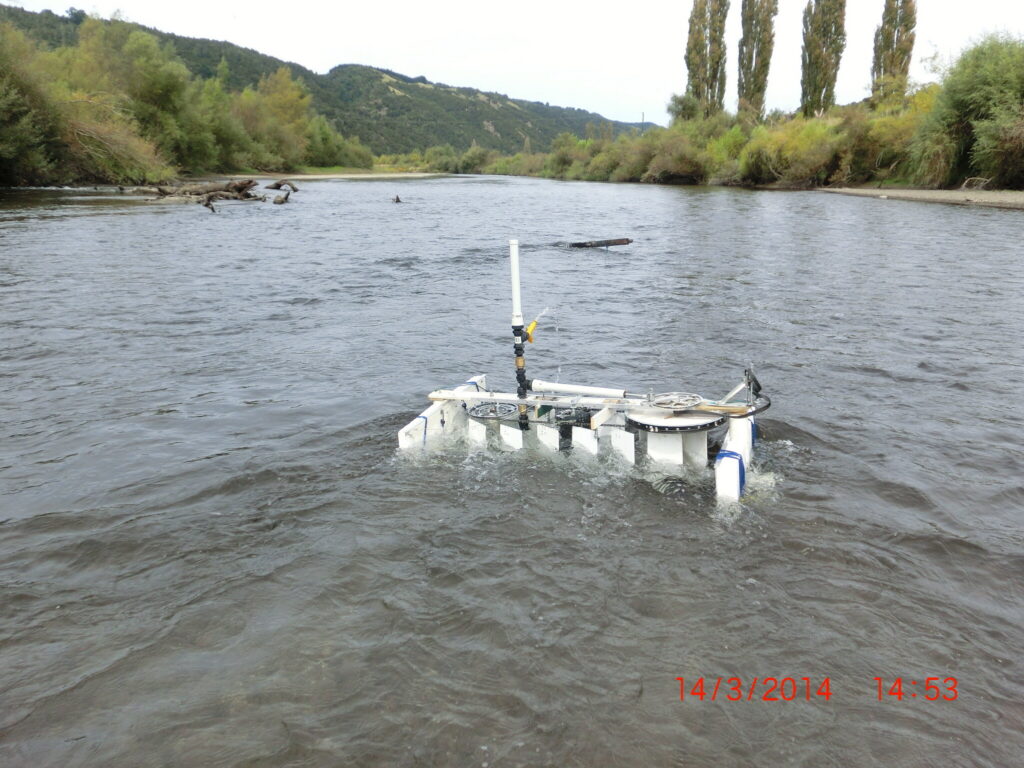
The mini linear turbine was tested upstream of Whakatane, both suspended from a rail in the river bed and floating in the river. Bicycle derailleurs were used part way along the upper chain to help prevent the chain from coming off. The turbine drove a water pump made from PVC pipe with two brass check valves.
7 April 2014 — Heathcote River, Christchurch
The mini linear turbine was tested in the Heathcote River using a bicycle-wheel step-up chain drive connected to a treadmill motor/generator. The generator produced 5 volts and powered a car tail-light bulb. A second recording documented voltage measurement during the test.
9 April 2014 — Rakaia River, Canterbury
The mini linear turbine was tested in the Rakaia River, Canterbury, pumping water while simultaneously generating electricity with the treadmill motor/generator to power a small car tail-light bulb. When the electrical load was disconnected near the end of the test, the turbine speed and pump flow rate increased slightly as the load was reduced.
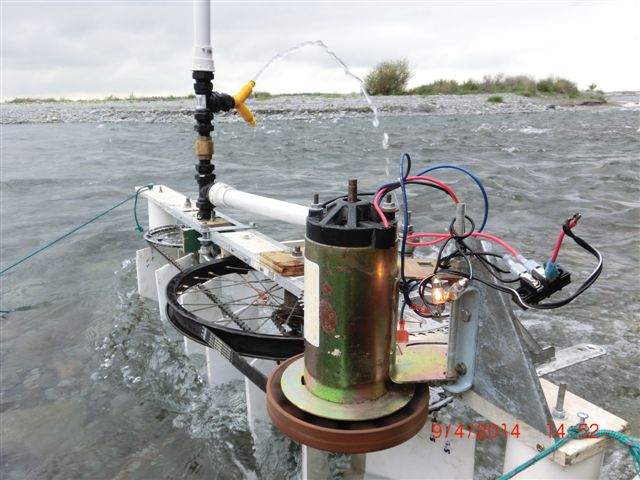
13 April 2014 — Heathcote River, Christchurch
The turbine was tested with the water pump disconnected and the generator powering a light bulb. During the test, some of the vanes were observed not to set correctly, possibly because of uneven river flow.
14 April 2014 — Heathcote River, Christchurch
Further testing in the Heathcote River investigated water pumping at different heads, vane operation, and simultaneous water pumping and electricity generation. The turbine pumped water to heights of approximately 5–6 metres. One test also showed a considerable reduction in turbine speed when the upstream flow was obstructed.
Pumping water to approximately 5 metres.
Water pumping at approximately 1 metre and 6 metres head.
Vane operation while pumping water to approximately 6 metres.
Simultaneous water pumping and electricity generation. Turbine speed decreases considerably when the upstream flow is obstructed.
Further Testing — 2015–2016
14 March 2015 — Waimana River near Whakatane
The mini linear turbine was tested in the Waimana River, about 6 km beyond Taneatua near Whakatane. During the test the turbine was used both to pump water and to generate electricity for a light bulb.
Original test video currently unavailable.
29 March 2016 — Flume Test
A controlled flume test of the linear turbine was carried out on 29 March 2016. The test included water pumping and measurement of the flow speed.